AI support for teachers
Helping teachers prepare lessons and check open answers in LearningBox.
Where would AI actually help?
I’m looking at two jobs teachers do in LearningBox: adding lesson material and checking students’ open answers. Before taking either feature further, we need to know whether it saves teachers work once they’ve checked and corrected the result.
Some answers can be checked with simple rules. Other tasks, such as drafting questions from a lesson, may benefit from a model. This project is about finding where that extra help is worth it.
An assistant in the lesson editor
I placed the assistant beside the lesson so teachers can check and edit its output without leaving the editor. They can import a document or ask it to draft questions from the lesson.
An imported document should keep its original text in editable blocks. Generated questions need a closer check: are they correct, at the right level, and do the answer options make sense?
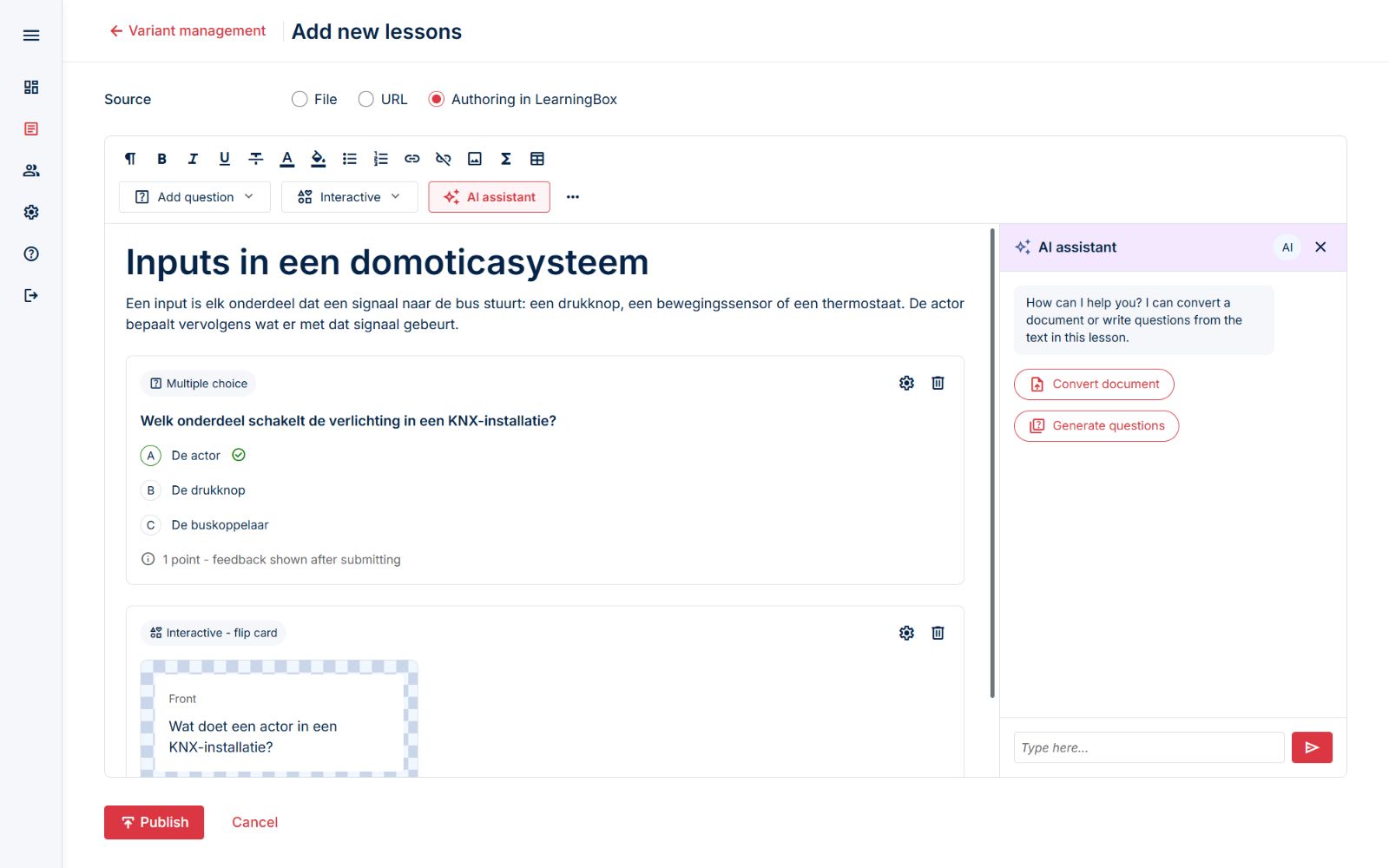
- 01Choose the sourceA document or lesson content
- 02Review the draftCheck text, questions and answer keys
- 03Edit and publishThe teacher decides what is ready
Two details still need work: asking the teacher to choose any missing correct answer, and showing which source the generated questions came from.
Checking open answers
The proposed flow starts with the accepted answer, then checks formatting and spelling differences. Answers that remain unresolved go to AI for a suggestion.
- Exact matchCompare with accepted answers
- Text rulesCheck harmless formatting differences
- Phonetic matchTest spelling variations in context
- AI reviewSuggest a verdict for unresolved answers
We need to test the rules as well as the model. Similar spelling or pronunciation doesn’t always mean the same answer.
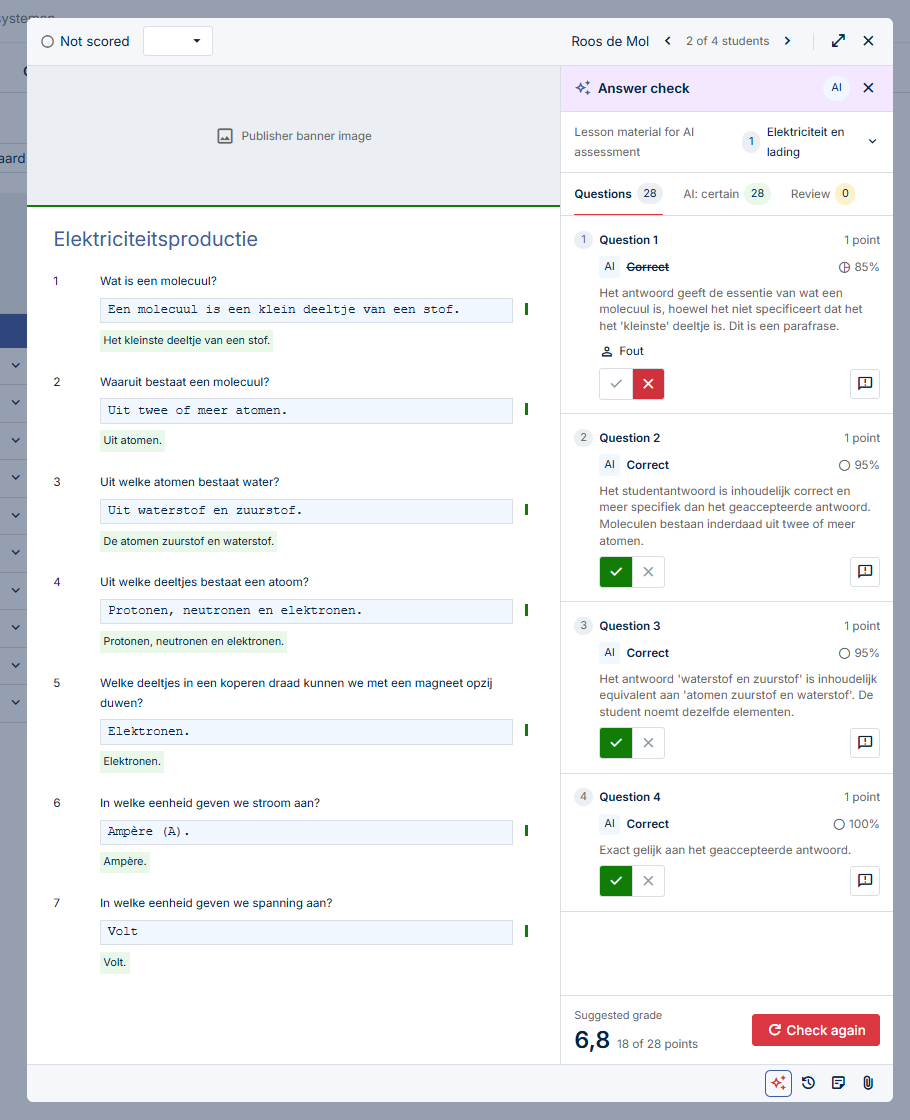
Here, AI accepts “a small particle” where the reference says “the smallest particle.” The teacher can read the explanation and mark it wrong. I want to test whether this view helps teachers catch that missing detail.
Illustrative prototype data.
Why we use an API
We’re a small development team, and a locally hosted model would be difficult for us to maintain. We use Claude through an API so we can spend that time on the product.
We’re comparing different Claude models. We still need to handle the data we send, failed requests and how the suggestions appear to teachers.
What we’re checking
I designed this dashboard so we can see usage, teacher corrections, errors, response times and costs in one place. It also marks when we switch models, so we can look into changes afterwards.
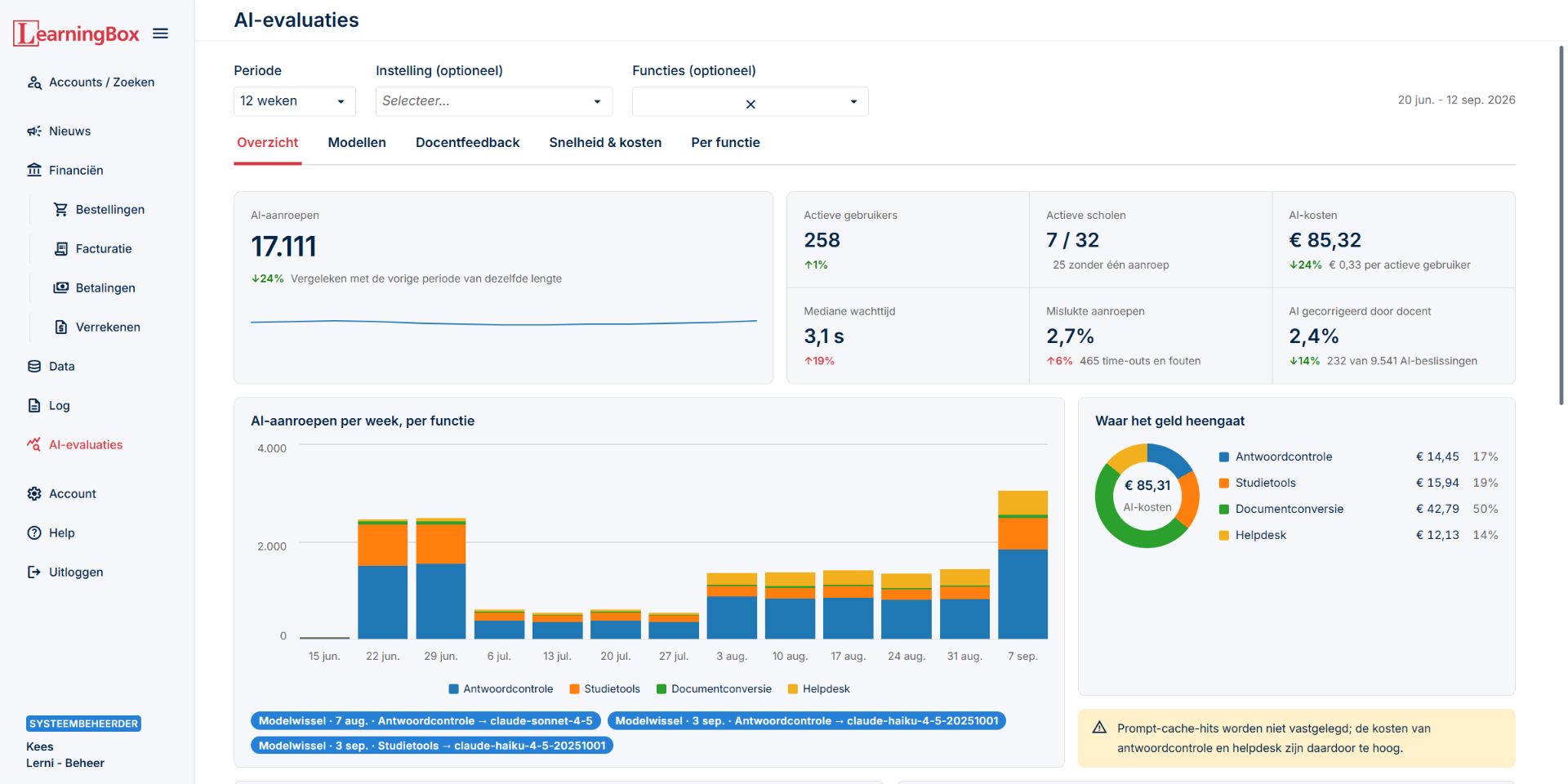
Dashboard mockup · Example data, not pilot results.
Wrong or missing content
Wrong answers accepted, text lost during import, and questions that are unclear.
Time spent checking
How long it takes to finish a lesson or review answers, including corrections.
Comparing models
Run the same examples through each model and compare response times, failures and cost.
Teacher corrections alone won’t tell us how accurate the suggestions are. We also need to check examples independently, including suggestions that teachers leave unchanged.
The EU AI Act and answer checking
Answer checking can affect a student’s assessment. The EU AI Act lists systems used to evaluate learning outcomes among its high-risk education uses. We need to assess how the rules apply to each feature and its intended use; a teacher approval button alone does not settle that classification.
For the design, this means teachers need to understand a suggestion, spot its limits and be able to reject or override it. Those are also part of the Act’s human oversight requirements for high-risk systems. I want to test whether teachers can do this in practice, including when the suggestion looks convincing but is wrong.
The classification and compliance assessment are still work to complete. The prototype shows the review controls we’re exploring.
Next steps
Next, we need a set of examples checked by teachers, and sessions comparing the same work with and without the assistant. We haven’t chosen a winning model or established a time saving yet.